
This page defines the dependency-injection vocabulary as Vauban materialises it. The model follows the Jakarta CDI 4.1 spec; implementation choices are described in Internals.
Bean
A bean is a class managed by the container: its lifecycle, its dependency resolution and its scope are controlled by Vauban.
Three conditions are enough for a class to become a Vauban bean:
-
The class is annotated with a scope (
@ApplicationScoped,@Singleton,@Dependent,@RequestScoped) or a stereotype. -
The class is visible from the
module-info.java(exportsor same module). -
The class shows up in the index produced by
vauban-indexerat compile time.
At compile time, every bean receives two generated artefacts:
-
a
_Factory— implementsBeanFactory<T>and knows how to instantiate the bean; -
a
_ClientProxy— only for normal scopes; intercepts calls and delegates to the active context.
Scope
A scope defines an instance’s lifetime and the context that holds it.
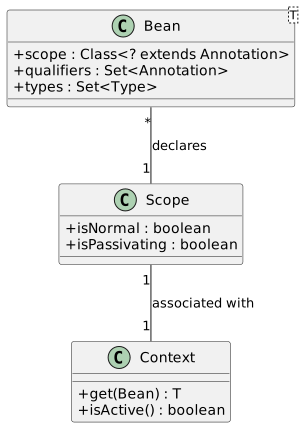
Implemented scopes: see the usage table.
Qualifier
A qualifier is a runtime annotation that discriminates beans of the same type. The Default qualifier is implicit. CDI ships @Default, @Any, @Named; Vauban supports all custom qualifiers, including those with @Nonbinding members.
Producer
A @Produces method or field produces a bean whose instantiation is not controlled by the container but by user code. The associated disposer (@Disposes) runs on destruction. Vauban emits a _ProducerFactory per producer method.
Observer
An observer is a @Observes or @ObservesAsync method that reacts to an application event. Async observers are dispatched on virtual threads. Observer resolution is static: the EventDispatcher consults a table built at compile time.
Interceptor
An interceptor wraps a method invocation (@AroundInvoke) or constructor (@AroundConstruct). Interceptor chains are resolved at compile time and stored in the bean’s _Factory.
BeanManager
The BeanManager is CDI’s SPI façade. Vauban exposes it as VaubanBeanManager, read-only for application code. It allows:
-
programmatic bean resolution (
getBeans(Type, Qualifier…)); -
observer resolution;
-
access to active contexts.
The historical mutable methods (addBean, addObserverMethod) are unavailable: everything is frozen at build time.
Injection graph

The user never touches the _Factory classes. They call Vauban.bootstrap(), select a root bean, and the container does the rest.
Build Compatible Extensions
CDI 4.1 introduces Build Compatible Extensions (BCEs): @Discovery, @Enhancement, @Registration, @Synthesis, @Validation hooks executed at compile time. Vauban supports them natively since its entire flow is compile-time. See vauban-test-suite for custom BCE examples.
Differences from CDI Full
Vauban implements the Lite profile. The following are absent:
-
runtime portable extensions (
Extension,BeforeBeanDiscovery, etc.) — replaced by BCEs; -
@Specializes; -
@ConversationScoped; -
passivation (
PassivationCapable); -
EL (Expression Language) wired into managed beans.
See the comparison table.