
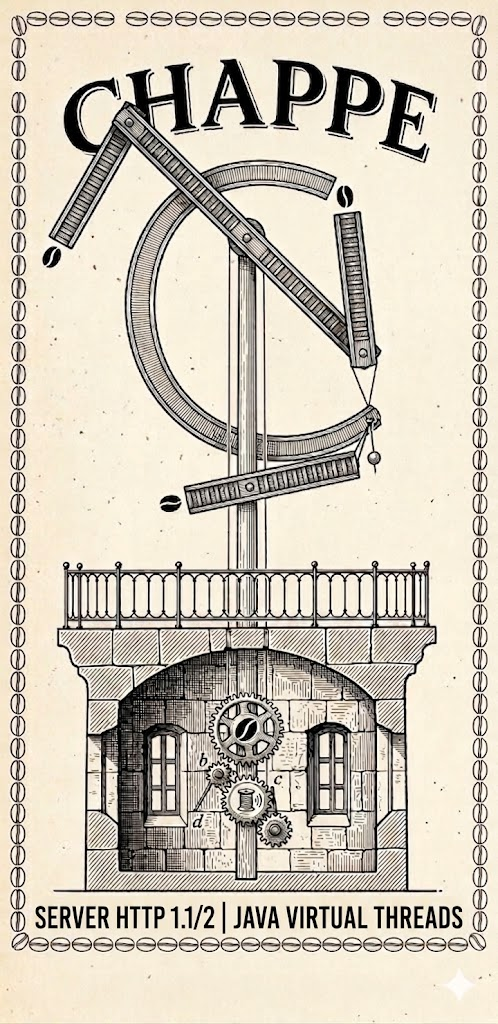
Chappe is a high-performance HTTP server written in pure Java 25 with no runtime dependency outside the JDK. It implements HTTP/1.1 (RFC 9110/9112), HTTP/2 (RFC 9113) and — eventually — HTTP/3 (RFC 9114). It is the transport layer of the Vidocq ecosystem: Foy (Servlet) and Cassini (REST) mount on top.
Origin of the name
Claude Chappe (1763-1805), a French engineer, invented the optical telegraph that went into service in 1794. His network of 556 hilltop stations with articulated semaphores spanned France and could carry a message from Paris to Toulon in under fifteen minutes — the first real long-distance communication infrastructure, decades before Morse.
The metaphor holds in two ways:
-
Chappe (the server) is the transport layer — it moves bytes around with no application logic, exactly like an optical station relayed codes without interpreting them.
-
The French telegraph administration was later inherited by Alphonse Foy in the 19th century. In Vidocq, Foy (Servlet 6.1) inherits the Chappe transport in the same way.
At a glance
Implemented specs |
HTTP/1.1 (RFC 9110, RFC 9112), HTTP/2 (RFC 9113), HTTP/3 (RFC 9114, planned) |
Repo |
|
Java |
25 (LTS) |
Java modules |
|
Runtime dependencies |
none (JDK only) |
Conformance |
45 RFC tests in |
TCK |
not applicable (no official HTTP TCK) |
Position in the ecosystem
Chappe sits at the heart of transport: every Vidocq module that speaks HTTP goes through it.

Chappe also runs without any extension: that is what its chappe serve CLI does to ship a static site to production.
Identity traits
-
Strict Java 25 —
ScopedValue(JEP 506), exhaustive pattern matching, sealed interfaces, records. -
Virtual threads — one virtual thread per connection, no platform pool, no application-side
Selector. -
Strict Java Modules — every module ships a
module-info.java, minimal exports, no classpath fallback. -
Zero dependency — no transitive logger, no external utility library. JUnit only for tests.
-
Static codegen —
chappe-static-index-maven-pluginproduces the O(1) index and.gzsidecars at build time. -
Zero-copy I/O —
FileChannel.transferTo()for static files and pre-compressed sidecars.
Performance
Quick read (TL;DR, canonical table, JFR profile, native vs JVM): Performance page. The full log of all runs (closed-loop in-process and open-loop wrk2), detailed methodology and history of optimizations live in lien:https://codeberg.org/Vidocq/chappe/blob/main/BENCHMARKS.md[BENCHMARKS.md].
Quick links
-
Getting started — first server in under 30 lines.
-
Usage — TLS, HTTP/2, virtual hosts, static files, compression, CLI.
-
Concepts — connection, frame, multiplexing, scoped values.
-
Internals — HTTP/1.1, HTTP/2, HTTP/3 pipelines; threading model.
-
Reference — Maven coordinates, Java Modules packages, public API, Maven plugin.
-
Migration — from Netty, Undertow, Jetty, JDK HttpServer.